On this page7
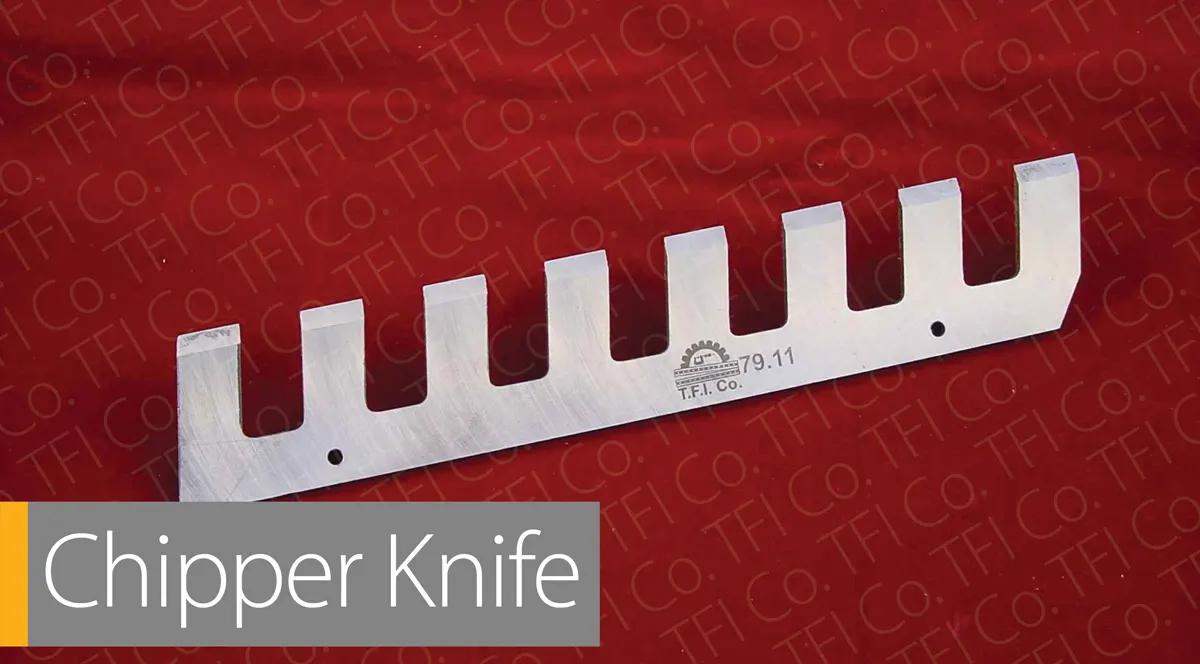
Chipper knives for drum and disc wood chippers, made to your drawing. TFI Co. has made steel blades since 1965, including knives for the woodworking industry. We supply sawmills, biomass plants, pallet makers, machine dealers and distributors who order 50 to 5,000+ pcs.
- Knife types
- Chipper knives and counter knives (anvils) for drum and disc chippers
- Steel
- Tough tool steel, chosen for clean or dirty wood
- Made
- To your drawing, to a sample, or from your machine model
- Sets
- Supplied in matched sets, so the rotor stays balanced
- Quantity bands
- 50–199 · 200–999 · 1,000–5,000 · 5,000+ pcs
- Price
- On request, per quantity band
How a chipper knife works
In a drum chipper, the knives sit on a turning drum. In a disc chipper, they sit on the face of a heavy disc. In both, the knife cuts the wood against a fixed counter knife, also called the anvil or bed knife. The gap between knife and counter knife sets the chip size. When the knife is dull, the chips get uneven, the dust increases and the machine needs more power.
Clean wood or recycled wood
Fresh logs and clean offcuts are easy on the edge. Recycled wood, pallets and wood with bark, sand or nails wear and chip the edge much faster. For dirty wood, a tougher steel that does not chip is better than the hardest steel. Tell us what you chip, and we choose the steel for it.
Keep the set balanced
Chipper knives turn fast. If the knives in one set have different weights, the rotor vibrates and the bearings wear. Always fit knives as a matched set, and regrind all knives of a set to the same size and angle. This is one more reason to order the whole set at once, in one batch.
Regrinding tips
Keep the original bevel angle when you regrind.
Grind with coolant, so the edge does not overheat and lose hardness.
Check the knife width after each regrind; reset the gap to the counter knife.
Replace the knife when it reaches the minimum width given by the machine maker.
Keep the original bevel angle when you regrind.
Grind with coolant, so the edge does not overheat and lose hardness.
Check the knife width after each regrind; reset the gap to the counter knife.
Replace the knife when it reaches the minimum width given by the machine maker.
Send these details for your bulk quotation
Knife length × width × thickness (mm), and the bevel angle
Hole or slot pattern, or the machine make and model
Drum or disc chipper, and how many knives in one set
The wood you chip: fresh, dry or recycled
Quantity band, and one-off or repeat order
Knife length × width × thickness (mm), and the bevel angle
Hole or slot pattern, or the machine make and model
Drum or disc chipper, and how many knives in one set
The wood you chip: fresh, dry or recycled
Quantity band, and one-off or repeat order
No drawing? A phone photo of the knife you use now, with a tape measure beside it, is enough to start.
How a bulk order works
You send
the sizes, drawing or machine model, and your quantity band.
Our team checks
the size, holes, angle and steel, and asks if anything is missing.
You receive a written quotation
for your quantity band.
You approve
the drawing and the quotation, and production starts.
You send
the sizes, drawing or machine model, and your quantity band.
Our team checks
the size, holes, angle and steel, and asks if anything is missing.
You receive a written quotation
for your quantity band.
You approve
the drawing and the quotation, and production starts.
For repeat orders, we keep your drawing on file, so the next batch is the same part.
Where chipper knives are used
Drum and disc wood chippers
Sawmills and pallet makers
Biomass and wood-fuel plants
Wood recycling
Particle board and pulp plants (see also our particle board blades)
Drum and disc wood chippers
Sawmills and pallet makers
Biomass and wood-fuel plants
Wood recycling
Particle board and pulp plants (see also our particle board blades)
Do you make the counter knife too?
Yes. Send the size of the counter knife (anvil) with the chipper knife, and we quote both.
Which steel is best for recycled wood?
A tougher steel that resists chipping. Tell us what is in the wood (nails, sand, bark) and how long your present knives last.
What is the smallest order?
These pages are for bulk orders from 50 pcs. If you need fewer, say so in the form and our team will tell you what is possible.
How is the price set?
The price depends on the size, the steel and the quantity band. You receive a written quotation before you order.
- Section
- Shear and Straight Knives
- Updated
- 19 November 2026
- Reading time
- 3 min read
Ready to order in volume?
Orders from 50 to 5,000+ pieces. Send your size or drawing and the quantity, and our team replies with a quotation.
Request a volume quote