On this page7
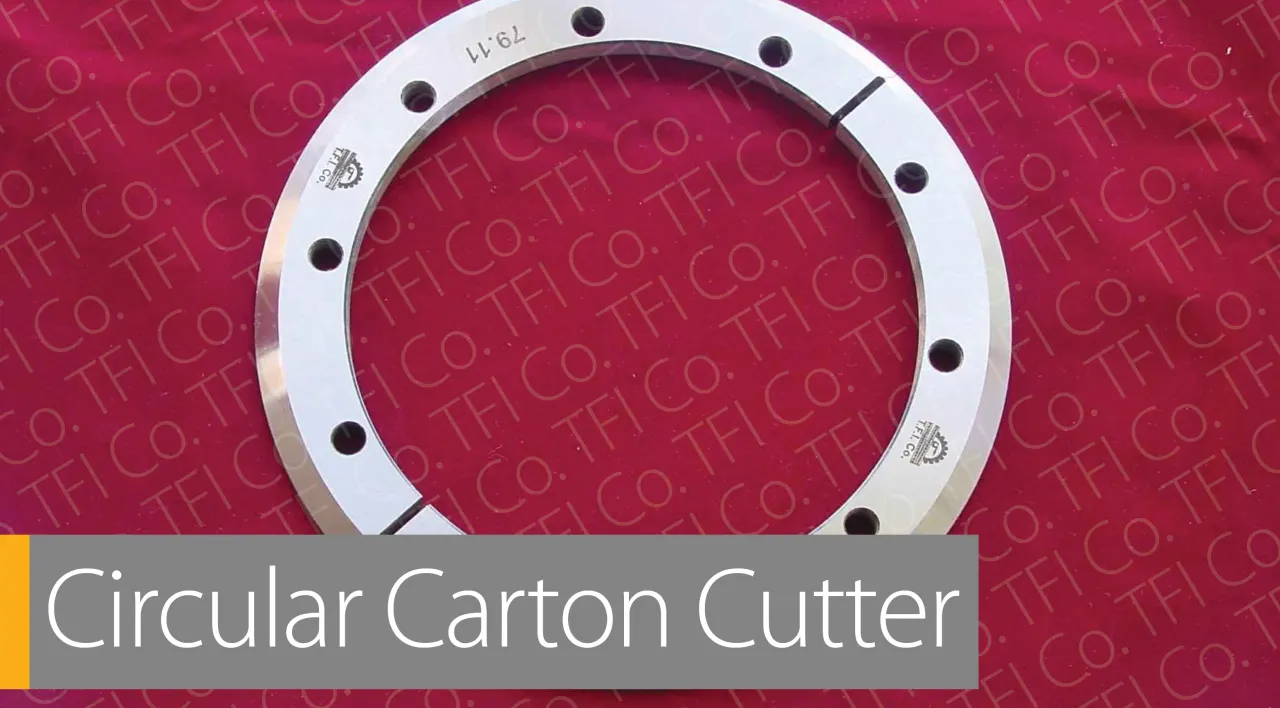
Circular blades for tissue log saws, made to your drawing. TFI Co. has made steel blades since 1965, including circular knives for paper converting. We supply tissue converters, machine dealers and distributors who order 50 to 5,000+ pcs.
- For
- Log saws on toilet-roll, kitchen-towel and industrial roll lines
- Shape
- Large circular blades with a double bevel
- Made
- To your drawing, to a sample, or from your log saw model
- Steel
- Chosen to hold an edge through constant on-machine sharpening
- Quantity bands
- 50–199 · 200–999 · 1,000–5,000 · 5,000+ pcs
- Price
- On request, per quantity band
How a log saw blade works
A tissue line winds long "logs" of tissue. The log saw cuts each log into rolls. Its circular blade turns fast and moves through the log many times per minute. Grinding wheels on the machine sharpen the blade while it works. Every sharpening takes a little steel, so the diameter gets smaller until the blade reaches the minimum size and must be changed.
Why the steel matters
Tissue is soft, but it contains fibres and fillers that wear the edge. Because the blade is sharpened all the time, the steel must grind cleanly and keep a strong edge after each pass. A blade that is too soft wears fast; a blade that is too hard can chip or crack. The heat treatment must also keep the blade flat, so it runs straight through the log.
What causes poor cuts
Rough or "fluffy" roll ends: the edge is dull or the sharpening is not working well.
Rolls cut at an angle: the blade runs out of true or is not flat.
Burn marks: too much friction, often from a dull edge or wrong grinding.
Short blade life: the steel or hardness may not suit the paper or the grinding setup.
Plan your blade stock
Each log saw uses blades at a steady rate. Count how many blades you use per month, and order a quantity band that covers several months. A fixed drawing and one batch give the same steel and the same size every time.
Send these details for your bulk quotation
Outside diameter × bore × thickness (mm), and the bevel
Fixing holes, pin holes or flange details
Log saw make and model
The paper you cut: toilet tissue, towel or industrial rolls
Quantity band, and blades used per month
Outside diameter × bore × thickness (mm), and the bevel
Fixing holes, pin holes or flange details
Log saw make and model
The paper you cut: toilet tissue, towel or industrial rolls
Quantity band, and blades used per month
No drawing? A phone photo of the knife you use now, with a ruler across the diameter and the bore, is enough to start.
How a bulk order works
You send
the sizes, drawing or machine model, and your quantity band.
Our team checks
the diameter, bore, thickness, bevel and steel, and asks if anything is missing.
You receive a written quotation
for your quantity band.
You approve
the drawing and the quotation, and production starts.
You send
the sizes, drawing or machine model, and your quantity band.
Our team checks
the diameter, bore, thickness, bevel and steel, and asks if anything is missing.
You receive a written quotation
for your quantity band.
You approve
the drawing and the quotation, and production starts.
For repeat orders, we keep your drawing on file, so the next batch is the same knife. We can also plan batches to match your yearly use.
Where tissue blades are used
Toilet-roll and kitchen-towel lines
Industrial and jumbo roll converting
Tissue machine dealers and service companies
Distributors of converting spare parts
Toilet-roll and kitchen-towel lines
Industrial and jumbo roll converting
Tissue machine dealers and service companies
Distributors of converting spare parts
Can you make a blade for my log saw model?
Send the model and the blade sizes, or a drawing. We make log saw blades to drawing.
What is the minimum diameter for my blade?
The machine maker sets it. Tell us the value from your manual, and we quote the new blade size.
What is the smallest order?
These pages are for bulk orders from 50 pcs. If you need fewer, say so in the form and our team will tell you what is possible.
How is the price set?
The price depends on the size, the steel and the quantity band. You receive a written quotation before you order.
- Section
- Slitter and Circular Knives
- Updated
- 19 November 2026
- Reading time
- 3 min read
Ready to order in volume?
Orders from 50 to 5,000+ pieces. Send your size or drawing and the quantity, and our team replies with a quotation.
Request a volume quote