On this page7
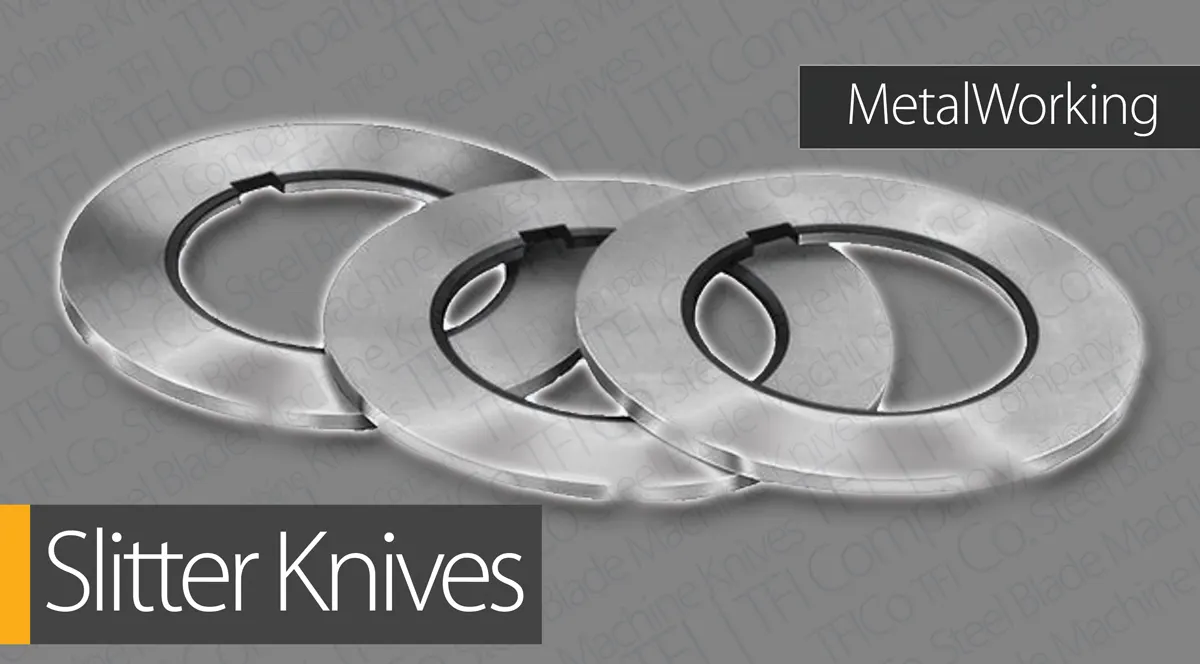
Slitter knives for metal coil slitting lines, made to your drawing. TFI Co. has made steel blades since 1965. We make circular slitter knives for steel service centres, strip mills and tube mills, and for distributors who order 50 to 5,000+ pcs.
- For
- Steel, stainless steel and aluminium coil slitting
- Example
- ø400 × ø260 × 15 mm slitter knife
- Steel
- Tool steel, heat-treated for toughness and edge life
- Edge
- Fine-ground cutting edges for clean, low-burr slitting
- Made
- To your drawing or sample
- Quantity bands
- 50–199 · 200–999 · 1,000–5,000 · 5,000+ pcs
- Price
- On request, per quantity band
How metal slitting works
A slitting line unwinds a wide coil and cuts it into narrow strips. On each arbour sits a row of circular knives. The top knives and bottom knives overlap a little, and the strip is cut between them, like scissors. The horizontal clearance between top and bottom knife and the overlap depend on the coil thickness and material. When they are right, the edge is clean and the burr is small.
Example: ø400 × ø260 × 15 mm slitter knife
- Size
- Outside ø400 mm × bore ø260 mm × 15 mm thick
- Steel
- Tool steel (LD + Ni), heat-treated
- Tolerances
- Made to DIN 7168 tolerances, as stated on the TFI Co. product sheet
- Edge
- Mirror-finished cutting edges
- Use
- Steel coil slitting and rewinding lines, including automotive sheet
- Size
- Outside ø400 mm × bore ø260 mm × 15 mm thick
- Steel
- Tool steel (LD + Ni), heat-treated
- Tolerances
- Made to DIN 7168 tolerances, as stated on the TFI Co. product sheet
- Edge
- Mirror-finished cutting edges
- Use
- Steel coil slitting and rewinding lines, including automotive sheet
What decides knife life
Coil material
stainless and high-strength steel wear knives faster than mild steel or aluminium.
Thickness range
thick coil loads the edge; thin coil needs a very sharp edge and exact clearance.
Flatness and thickness tolerance
in a set, all knives must be the same thickness, or the strip widths will vary.
Regrinding
each regrind makes the knife a little smaller. Regrind the whole set together, so the knives stay matched.
Burr and strip edge problems
A large burr usually means a dull edge or a clearance that is too big for the coil thickness. A torn or rough edge can mean the clearance is too small. Before you change knives, check the clearance and overlap. If the problem stays, the knives need regrinding or replacing.
Send these details for your bulk quotation
Outside diameter × bore × thickness (mm), and the keyway
Coil material and thickness range
Line make and model, and arbour diameter
How many knives in one set
Quantity band, and one-off or repeat order
Outside diameter × bore × thickness (mm), and the keyway
Coil material and thickness range
Line make and model, and arbour diameter
How many knives in one set
Quantity band, and one-off or repeat order
No drawing? A phone photo of the knife you use now, with a ruler across the diameter and the bore, is enough to start.
How a bulk order works
You send
the sizes, drawing or machine model, and your quantity band.
Our team checks
the diameter, bore, thickness, keyway and steel, and asks if anything is missing.
You receive a written quotation
for your quantity band.
You approve
the drawing and the quotation, and production starts.
You send
the sizes, drawing or machine model, and your quantity band.
Our team checks
the diameter, bore, thickness, keyway and steel, and asks if anything is missing.
You receive a written quotation
for your quantity band.
You approve
the drawing and the quotation, and production starts.
For repeat orders, we keep your drawing on file, so the next batch is the same knife. We can also plan batches to match your yearly use.
Where metal slitter knives are used
Steel and aluminium coil slitting lines
Steel service centres
Strip mills and tube mills
Automotive sheet suppliers
Distributors of slitting line spare parts
Steel and aluminium coil slitting lines
Steel service centres
Strip mills and tube mills
Automotive sheet suppliers
Distributors of slitting line spare parts
Do you also make top and bottom knife sets?
Yes. See our page on top and bottom slitter knives for metal, or send the sizes of both knives.
Can you match my existing knives?
Yes. Send the drawing, or the diameter, bore, thickness and keyway of your present knives.
What is the smallest order?
These pages are for bulk orders from 50 pcs. If you need fewer, say so in the form and our team will tell you what is possible.
How is the price set?
The price depends on the size, the steel and the quantity band. You receive a written quotation before you order.
- Section
- Slitter and Circular Knives
- Updated
- 19 November 2026
- Reading time
- 3 min read
Ready to order in volume?
Orders from 50 to 5,000+ pieces. Send your size or drawing and the quantity, and our team replies with a quotation.
Request a volume quote